
Her smile was a beam of light, a taste of life, but it looked wrong on her dying face.
”Mat..” She said.
”Matti is not here, it’s noght Little Misus.”
Elle’s breathing was shallow.
”Sing song Theli,” begged the girl, and Thelian sang.
“…and look, today just claws remain, no socly fly the air, battle and lusty…” He swallowed the words, skipping the verse, his voice shaking. “…don’t cry, nor kill, nor say farewell, love till the dawn comes red, tomorrow we shall all be gone, with iron pierced and de…”
His throat tightened on the cut-off syllable. The melody was sweet, but the words suddenly tasted like ash, like he had rubbed them out of the bottom of a pot. He had made it up one day, it had just come to him and made her giggle, but now, in the swelter of the room, the lyrics sat in his mouth like a curse he could not spit.
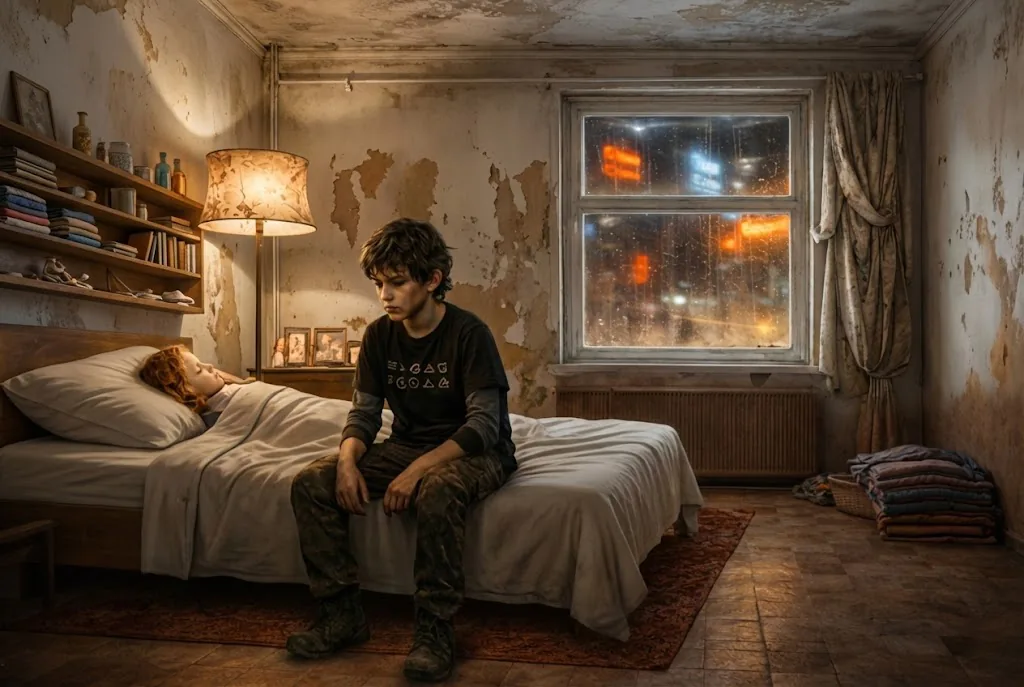
Each breath came late, as if the air had to be convinced. Heat poured from her skin in waves, trapped beneath the blanket, trapped inside the room. Sweat gathered on her forehead and ran into her hair, darkening the pillow beneath her head, carrying with it the faint sourness of fever and the sharper bite of the Medika’s clean-smelling lies.
Thelian sat beside the bed and watched.
The bedside table looked like a tiny altar that had failed. Two spoons lay crossed and smeared with blue dust that had worked into the metal seams. Foil scraps were folded into tight little squares, stacked by his knee because leaving mess was an invitation. A cooling patch clung crookedly to the wall near the bed, half peeled, its glue defeated by heat hours ago. The empty blister bumps, seven of them, stared up at him from the torn pack like blind eyes. The spoons were so small they might have been toys, their bowls barely the width of Elle's mouth
He did not reach for any of it again. His hands kept wanting to, wanting to try one more time, wanting to rub powder onto gums until his fingers bled. He held them on his thighs instead and pressed his nails into his skin until the urge went quiet.
There was no one to call. The landline in the living room had not worked for months, not since the service men stopped coming up this high unless someone paid in advance. Even if it had worked, nobody came for canal-block boys at wee hours unless the Order wanted you.
He knew what heart-fever did. He had watched it climb Krisel half a year ago and sit in her chest like a stone. He had watched Harri stand in the doorway with a paper and a number, ten thousand credits, said like a prayer that could buy a miracle. He had watched the number fail.
Knowing did not help. Knowing only made him careful with words. He did not say the name of it in his head now. He sat with his mouth shut and tried to force the room to agree with him by refusing to name what was happening.
Outside, neon lights flickered through the window in weak, uneven pulses. Red bled into white, white into blue, fractured by dirty glass filmed with fine grey dust and spore residue drifting in from the canal levels below. Above the city, Liir hung high and pale, distant and untroubled. Near the horizon, Ressor pressed low and red against the skyline, as if kissing the earth, as if seeding blood into the ground below.
The room did not cool. The air did not move.
Thelian closed his eyes and searched his mind for anything that was not this moment. He found only the old reflexes, the ones that had kept him from being thrown out like trash when he was smaller. Count. Fold. Apologize. Serve. Make yourself useful enough that the room kept you.
He leaned forward and tugged the blanket edge straight, even though it was already straight. He smoothed it once. Twice. A third time. Three was complete. He stopped on three because if he did not stop on three his hands would keep going until they split.
And then he began to speak.
”This is a story Mother told,” he whispered. ”About a small prince. His name was Randen.”
Elle’s eyes were open. Deep blue. Unfocused. But they moved when he spoke, tracking sound rather than sight, like her body had decided hearing was cheaper than looking.
”When hunger hollowed Udhafa, during the Chaos,” Thelian said, ”and the ground would no longer answer seed or spore, Randen took exile upon himself so his family might feed one mouth fewer.”
Her breathing rasped quietly, uneven but listening.
”Before he left, the elders told him of an old way beneath the city. A road sealed since the Chaos. A road that once led to Baramma, the island where the earth still remembered abundance.”
The lamp hummed softly beside the bed. Pipes along the ceiling cast long shadows that did not move, their surfaces veined with mineral stains and pale growths that thrived where warmth never faded.
”Randen went down into the deep places,” Thelian said. ”Stone opened into halls so vast the ceiling disappeared into darkness. Symbols lined the walls, marks no one living could read. Cold lights stirred without flame. And the floor itself carried him forward, lifting and moving as if the world had learned to walk before men ever did.”
He swallowed and tasted the thin blood from where he had bitten his tongue earlier in the Medika chute. The taste dragged him back for an instant, metal on metal, elbows banging, shoulder catching a seam, the pocket tearing like skin. His shoulder throbbed now when he breathed too deep. His cheek sting woke up if he turned his head the wrong way.
”Randen called it magic,” Thelian whispered, ”and hurried through before it could forget him.”
Elle’s lips parted.
”Bar…”
He nodded, even though she wasn’t looking.
”Baramma lay beyond the sea,” he continued. ”Crowned in ruin. The land was hostile. Its soil red and broken, crusted with ancient mineral salts. Its winds sharp with rot and spore-dust. Creatures without familiar shape hunted him there, and the island offered no mercy.”
Neon flared brighter for a moment, then dimmed again as an aircar hissed past the window, its passing wake making the sign outside stutter.
”Years passed,” Thelian said. ”Not counted by seasons. Only by endurance. Randen survived by hiding. By hunting when he had to. By learning which places even beasts would not touch, where fern-grass stiffened underfoot and the air itself tasted wrong.”
Her breathing slowed. Not better. Slower the way a candle burned low when there was nothing left to drink.
”At the island’s heart,” he said, and his voice roughened, “he found the Blood Ïsuulë flower.”
The word hung in the air, heavier than it should have been for a single sound.
”It did not bloom,” Thelian said quietly. ”It rose from torn ground like a wound that would not close. Crimson leaves, vast and serrated, veins dark and swollen with slow sap. Old leaves curled inward as they aged, clawing toward the plant’s own core. Others lay split and empty nearby, their dust carried away by the wind.”
Elle’s eyes glistened. ”Want Blood Ïsuu…”
Thelian’s fingers tightened on the blanket edge. The fabric creased under his grip, then he forced it flat again, as if flattening it could flatten the moment. His throat worked once, dry.
”One day,” he said, and the words came out too fast, like he had to get them out before the room could stop him. He leaned closer, close enough to feel the heat rolling off her skin, close enough that his hood shadow fell across her face and hid his eyes. ”I will get it.”
He swallowed and tried again, slower, making it into a rule.
”I will go to Baramma. I will find the Blood Ïsuulë. I will bring it back in my hands. I promise, Little Misus.”
His thumb brushed her knuckles, one small stroke, then another, counting without sound. He did not kiss her yet. Kissing felt like farewell.
He lowered his head until his forehead met hers.
The heat was immediate, blunt, not skin-warm but core-wrong, like pressing against a kettle that never cooled. Sweat filmed her brow and slicked onto him. He stayed anyway, holding the contact like an anchor, like if he kept his bones against hers the world could not take her without permission.
”You will see it,” he said against her skin, the words muffled, breath catching. ”You will hold it. You will smell it. You will laugh at me when I trip over my own feet bringing it to you.”
The little girl smiled faintly with an absolute trust that the world had not had time yet to erase from her.
Thelian held the smile like it was something he could keep by force. He lifted his head carefully, as if breaking that touch might crack something. Then he made his voice steady again because steadiness was service.
”Beneath the leaves,” he went on, ”was a low hollow that smelled sweet and wrong. Dead insects lay fused into the soil around it, their shells hardened into the ground. The air itself pressed heavy on Randen’s lungs.”
He leaned closer to the bed, careful not to bump her. Careful was a kind of worship.
”He stayed,” he whispered. ”No tale agrees why. Some say he ate the plant. Others say he only endured it. Many would have died there. Randen did not.”
”…the Traveller?” Elle murmured.
Thelian nodded.
”The Traveller did not call him that night,” he said. ”Nor the nights after.”
Elle’s lips curved faintly, almost a smile.
”When Randen left Baramma,” Thelian said, ”time no longer held him as it once had. Wounds closed too quickly. Hunger did not bite as deep. His strength outlasted exhaustion.”
Her breathing hitched, then came back thinner.
”He returned to Udhafa through the Bram Sea,” Thelian continued, his voice rough now, ”unchanged by years that should have claimed him. He tore stone with his hands. Raised shelters where roofs had fallen. Taught the people how to break the soil so it would feed them again.”
Outside, a siren wailed and faded, far away, somebody else’s problem.
”The Traveller never called Randen home,” Thelian said. ”He still walks the lands, helping those whose time has been taken too soon.”
Elle’s mouth moved again.
”Mo…”
”Yes,” Thelian whispered, and the word hurt. It hurt because it pulled up the image of Krisel’s last week, the way her mouth tightened when she tried not to cough, the way her hand trembled when she reached for water, the heat sitting wrong under her skin. He did not look at her eyes in his memory. Eyes held truth. ”Little Misus. He helped Mother too.”
He brushed the damp curls from Elle’s forehead. Her skin burned under his fingers, too warm, too light. He kept his touch small, two fingers only, because if he touched too much it would feel like grabbing and grabbing was what Harri did when he wanted something.
”She’s waiting for you,” he said softly. ”On the Traveller.”
He leaned in and kissed her brow.
Thelian did not cry. His eyes filled and then his body shut it down like a valve. He sat there, watching Elle’s face. It relaxed in a way it had not relaxed in days. The room did not get better. The room got quieter.
Liir above, stay white and near. The words came unbidden. The warmth that used to follow did not arrive. His hands stayed cold. Three years. Not finished.
He lay down next to her and stretched his arm out and laid Elle’s head on it, as if his skin could still be a pillow that mattered. Her small body was still warm when he hugged it tight, keeping the warmth in her a little longer, as if warmth was a thing that could be held by force.
Thelian got up slowly from the bed. The old twist flared when he put weight on it. He did not let it change his face. He slid Elle’s head onto the pillow with a gentleness that felt like obeying a rule, and he tucked the blanket edge under her chin, straight, straight, straight.
He glanced into the living room.
Harri lay sprawled on the sofa, a landslide of flesh frozen mid-collapse. One arm hung over the edge, the other crushed beneath him. His chest rose and fell with a wet, rattling snore, breath dragging like it had to pass something broken on the way in.
He had come home like this. Late. As always. No greeting. No attention for him or Elle.
His face was bruised and swollen, one eye nearly shut. A split brow had dried into his skin, blood cracked and dark. Cuts marked his mouth and nose. His forearms were scored with scrapes and shallow gashes, earned elsewhere. Streets. Alleys. Places where men like Harri went to spend their anger.
The room told a different story. Not of a fight, but of neglect. Two chairs by the table, one upright, the other tipped over and forgotten. The television hissed with static in front of the sofa, its pale flicker washing the walls. On the small round table beside it, the landline sat untouched, receiver neatly in place, dusted with a faint grey film.
Black sludge crusted Harri’s beard and collar, stinking of sewage, algae, and old chemicals. One boot dangled off the sofa, mud smearing the floor in a brittle arc. The silver ring in his ear caught the neon light, sharp against ruined flesh.
Beneath his tights, half-hidden by his thigh, a silver gun rested against his leg. Clean. Polished. Waiting.
Thelian stood still. He already knew the sequence.
When Harri woke, the anger would wake with him, loud and blind, searching for an outlet. It always did. It always needed a body.
This time, it would not be Elle.
The thought did not feel like victory. It felt like a job changing hands. The room choosing the next thing to break.
Thelian’s gaze flicked to the gun and then away, fast. His hands twitched once inside his sleeves, the old impulse rising like a cough.
Fix it. Make it right. Make it quiet.
He crossed the living room on the edges of his feet, not stepping on the worst patches of grime as if avoiding them kept him from making more. He stopped by the tipped chair. He did not grab it all at once. He touched the leg first, a test, then lifted, slow, careful, easing it upright without letting it scrape. The chair settled with a soft knock that sounded too loud in the static.
His throat tightened. He froze, listening.
Harri’s snore rattled on.
Thelian let out one thin breath and moved again. He went to the boot smear on the floor. The mud had dried into a brittle half-moon, the kind of mark that could sit there for days and still look like blame.
He pulled the hem of his shirt down, then stopped. Shirt meant skin. Skin meant bruises. Bruises meant questions.
He reached instead for the rag hanging from the sink hook, the one that used to be white before it became a permanent grey. He folded it once, then again, making a neat square because squares behaved. He crouched and wiped the mud in one fast stroke. It smeared. His stomach clenched.
He wiped again, slower. The smear thinned. He wiped a third time, pressing harder until the grit bit into his knuckles. He counted under his breath without letting the numbers become sound.
One. Two. Three.
The tile showed through. Not clean, not truly, but less marked.
He folded the rag in on itself so the dirty part disappeared, then folded again, small and tight, as if he could make the mess vanish by shrinking it. He set the rag on the table with the receiver, aligning its edge to the table’s edge. Straight. Parallel. Obedient.
The television hissed. The pale flicker crawled over Harri’s face, over the bruises, over the gun’s clean line under his thigh.
Thelian’s hand rose toward the power button and stopped in midair. Turning it off meant touching. Touching meant standing there long enough for Harri’s eyes to open.
He pulled his hand back and tucked it against his ribs, gripping his own sleeve until the cloth cut into his fingers. Better to leave the noise than to wake the body.
He did not reach for it. He kept his hands full of nothing and made himself smaller instead, shoulders rounding, chin down, the old posture that asked permission to exist.
He backed away without turning his back on Harri, the way you backed away from a beast that might wake. His heel nudged a small bit of grit and he flinched, then moved his foot again, setting it down more carefully, quieter, as if quiet could earn a passing word.
Fatigue pulled at him, thick and insistent, but he straightened against it and turned back to the bed.
Elle lay still.
He took her small hands in his. They were pink, light, already losing warmth. He rubbed her fingers between his palms once, twice, three times, like friction could call her back. He stopped on three.
Bent over her body, his thoughts loosened, drifting toward the same dream that had come to him again and again these past nights, a white mountain range blinded by snow, empty except for five riders cresting a distant ridge.
Snow and wind.
Maybe death was just that. Clean. Cold. Silent.
He leaned in close enough to smell the last sour trace of fever on her skin.
”Safe travels, Little Misus,” he whispered, his throat raw. ”Give the Traveller a kiss. And when you arrive… tell Mother I’ll come soon.”
He found the drawing and slipped it into his jacket pocket. He gathered the foil squares and tucked them into his pocket. He pressed the knot flat. He went into the bathroom and shut the door quietly behind him.
The old neon tube flickered when he flipped the switch, humming in darkness before sputtering into a weak yellow glow. Heat sat in the tiles like a living thing. The rain had stopped, and the apartment held onto its breath.
He had taken his jacket off in the room because the air was too thick to wear anything that heavy. Now he stood in his T-shirt, sweat already cooling on his spine, and the mirror tried to catch his face and throw it back at him.
He did not give it the eyes.
He kept his chin down. A dark bloom sat beneath his right eye. It had come from the Medika. He watched it instead of himself. If Harri saw it, Harri would decide what story it meant. If Harri decided it meant trouble, trouble would arrive.
He washed his face and dried with the old towel, straightening its edge on the hook,
He had been thinking about Baramma long before the Medika. That was why he had chosen the practice at the ISEMH center.
Not because it paid, though it did, barely. Not because he wanted the work. He hated most of it. Many of the men who ran the place were cruel, eager to teach hardness as virtue, obedience as survival. The tasks they set were worse. Brutal. Unnecessary. Wrong. The sleeping pale bodies behind glass made his stomach twist, and he swallowed it down because swallowing was what he did when the world was bigger than him.
But not all of them were the same.
Some did the work without spectacle. Without relish. Aeron was like that.
Stable. Predictable. He did not look at Thelian the way other men did, not quick and sideways, not with that flicker that landed on the eyes and then turned into a decision. Aeron's gaze went where it was supposed to go, hands, tools, the line you had to cut, the latch you had to turn. If he noticed the blue, he did not feed it. He did not make a face. He did not say demon as if it tasted good.
He showed Thelian where to stand, when to look away, when to finish what had already been started. He swore when a job went wrong and swore when it went right, the same flat work-language either way, and somehow that steadiness felt like mercy. When the shift broke, Aeron always had a piece of something in his pocket, half a bun, a strip of dried fern-meat, and he shoved it over without ceremony, like it was obvious Thelian would eat because of course he would.
Once, when Thelian's hands had shaken so hard he could not get the latch to catch, Aeron had not barked. He had just put his own hand over Thelian's for a breath, heavy and warm, and held it still. Not soft. Just certain.
"Good," Aeron had said when it finally clicked. One word, like a stamp. He splashed water again and looked at himself one more time.
His eyes were too blue. He hated that. Not in the preacher way. In the practical way. Blue meant noticed. Blue meant remembered. Blue meant a guard’s voice on a clean floor saying, Demon eyes, and the way the beam stayed steady after that, no searching, no doubt.
He could still hear it if he let himself.
He did not let himself.
He wiped the sink rim after he used it because water spots looked like guilt.
The thought returned. I should die too. It felt correct. It felt like settling a debt with the only thing he had left to offer. If he did it right, Harri would not have to look at him anymore.
His eyes dropped to the shelf by the sink.
Harri’s shaver lay there, clean and blunt-edged, the kind of utilitarian thing that outlasted neglect because it asked for nothing. Thelian picked it up without thinking at first, then held it a moment longer as the weight of it settled into his palm. Cold. Solid. Small.
He could sell it. Trade it. Sixty credits, maybe. Enough to keep Matti fed for a day or two. Enough to buy water later, if he had to walk a long way.
He turned it once in his fingers, then once more, and set his thumb against the edge like he was testing it. Not cutting. Measuring. How much it would hurt. Whether pain could make him brave.
He slid it into the inner pocket of his jacket instead, the metal pressing cold against his ribs, close to the drawing and the folded foil squares. He did not give it a name.
Then he pulled the jacket on.
Carefully, he lifted Elle into his arms. She weighed almost nothing. The lack of weight nearly made his legs buckle. His shoulder flared when he adjusted her, and he swallowed a sound, because sounds woke Harri, and waking Harri changed the night.
With one hand, he opened the chain and stepped into the stairwell. He took the elevator down, carrying her carefully. ”Me! I press it!”
Her voice echoed painfully in the hollow space. He swallowed and looked away as the doors slid open.
Morning was heavy with canal moisture. He kept his hood low and walked on the edges of puddles. By the time he reached the Medika, his arms were numb. His shoulder burned. His ankle clicked with each step, a small dry complaint. He timed his approach the way he timed everything now, using the quiet hour when shift changes made the building pretend it could watch itself. He avoided the brightest entrance lane and cut along the side where the lights flickered and the glass did not reflect as cleanly.
He heard the guard’s voice anyway, like a hook brushing skin.
Canal-block rat. Demon eyes.
The burial entrance was clean and new. A framed sign hung beside the capsules.
ORDER OF RANDEN Life is a debt. Labor is prayer. Destiny is the path by which the flesh returns to flame.
Under it, in smaller letters: VERIFICATION REQUIRED. SUBSCRIPTION TIERS APPLY.
Thelian placed Elle into a capsule at waist height. The motion was careful, precise, as if care still mattered. He adjusted her nightshirt hem so it did not bunch under her ribs. He tucked her hair behind her ear and smoothed it once, twice, three times. He stopped on three and forced his hands away.
He took Harri’s bank card from his pocket.
”Don’t even dream about it,” Harri had snarled when Thelian asked about burial costs.
The terminal blinked awake.
It blinked twice, stuttered, then settled into a bright screen that pretended it had never failed. A little spiral-tree logo spun in the corner as if it was thinking hard.
SELECT SERVICE CONFIRM LINEAGE CONFIRM PAYMENT NON-SUBSCRIBERS: LIMITED OPTIONS
Thelian’s fingers tightened around the card. His hands wanted to wipe the screen first. Dust sat at the edges where nobody touched, grey on white. He wiped it with his sleeve anyway, quick and small, then apologized under his breath without sound and pressed the card down.
A prompt flashed: VERIFICATION REQUIRED. Then it flickered and changed its mind, as if the building was tired of doing its job.
He drained every imperial credit of Harri’s unemployment stipend. Then his own savings. All together two thousand nine hundred and fifty imperial credits.
The numbers dropped on the screen like a verdict.
Tree options filled the display.
Cheapest was sealbark, 1000. Then scalewood, 1900. Aragwood, 1928.
He chose the most expensive option he could touch. A largtree.
The credits were barely enough. The balance dropped to almost nothing. He did not hesitate. Elle deserved the best. If he could not fix her, he could at least keep her from being filed away like trash.
The model showed a floating tree. It reminded him of her anyway.
A small, weightless joy, held aloft in a world that preferred everything to fall.
He selected a plot north of the city. Coordinates locked. [N 67° 51’, E 37° 52’]
He read them again anyway. He mouthed the degrees without sound. Fifty one. Thirty seven. Fifty two. He pressed his tongue to the back of his teeth as if the numbers could slip out otherwise.
He folded the receipt into his pocket. Outside, the thought struck him without warning.
Harri would wake up. He would see the transaction. There would be no forgiveness.
Thelian’s mouth went dry. He pictured Harri standing in the doorway, not drunk, not loud, the quiet kind of anger that did not waste itself on shouting. The kind that watched you, decided what you were, and then acted like the decision was just math.
If Harri saw the card charge, Harri would not ask why. He would not hear Elle’s name. He would not see the little body that had weighed nothing in Thelian’s arms. He would see theft. He would see disobedience. He would see proof that Thelian ruined things even when he tried to be useful.
The receipt square pressed against his ribs through the pocket cloth. The drawing pressed against it. Paper on paper. A thin stack of proof that he had done something, that he had not just watched her go.
He told himself he would be gone before Harri woke. He told himself it like a rule. A plan. A straight line.
His fingers flexed. Once. Twice. Three times. He made them stop.
Not because he wanted to live. Because leaving a mess was what bad people did. Because Harri hated mess. Because if he was going to be erased, he would do it cleanly, quietly, without making anyone have to deal with him twice.
He shifted his weight and felt his ankle answer with a dull throb, the old twist waking up when it remembered it had a job. He adjusted his stance so the limp would not show as much. He counted his breaths until they matched.
One. Two. Three.
Then he moved, fast and small, as if the city could still be convinced he was nothing. He had a delivery to make.