"May the Meir pass you by. Our time is short, and labor waits."
A voice greeted Harri from the darkness without urgency, which somehow made it worse.
"They do lurk in shadows," another voice added. "Don't they?"
"Oh yes. They were spared once. That was the greatest mistake," came the answer from the dark. "Mercy remembered too long becomes ten thousand imperial credits of debt."
Harri's living room did look broken into, but it always did. Bottles clustered near the walls where they had rolled and been ignored. Old plates sat where they had been left, grease hardened into dull skins, film-thin and cracking at the edges like dried sap. Furniture had shifted over time by inches, not only from violence, but from a man passing through it again and again without ever setting anything right. The room carried the quiet disorder of something long unattended, as if neglect itself had been allowed to settle and claim a place.
The bag was pulled from Harri's head.
Light flooded in.
Harsh.
White.
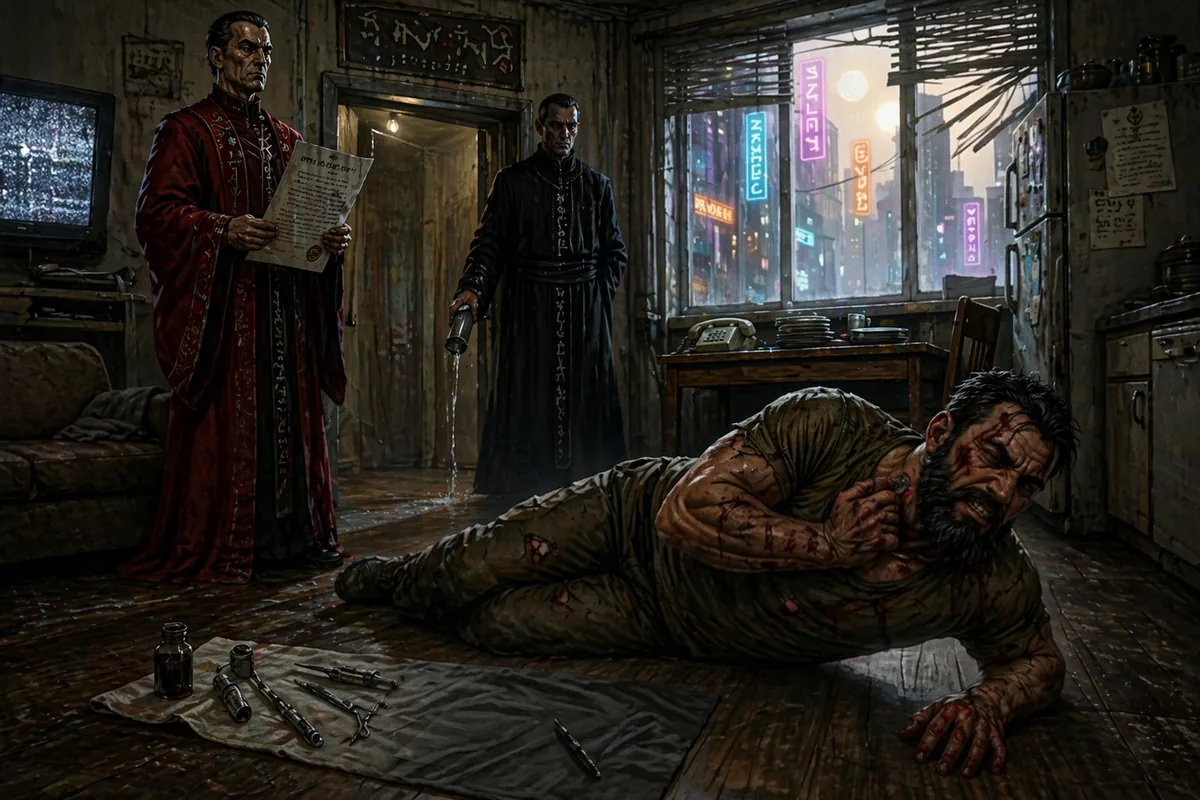
Two priests from the Order of Randen stood in front of him. One in red robes, the other in black.
The red priest dragged a chair upright with his foot and sat, as if sitting itself were his allotted task, something to be performed correctly and without flourish. The fabric of his robe whispered as he moved. His collar clasp caught the light, bronze gone dark with wear, the cracked orb and flanking gems of the Crest pressed into the metal as if branded there. Across from him, another priest stood in black, arms folded, face unreadable. He nodded once, not in agreement, but in acknowledgment, like a mark placed beside a finished line.
Neon leaked through cracked blinds from the street below, bleeding bruised reds and sickly purples across the walls. Fine dust and spore residue drifted in the beam, turning the light granular. The television, still on, hissed softly with static, its pale flicker washing over the room without meaning. Burning power nobody was paying for. A system running on credit it did not have.
Harri blinked and snarled.
He was still wearing the clothes from the canals. They clung to him, stiff with dried filth and sewage, the fabric crusted with mineral grit and black canal slime. The smell had soaked into the cloth, into his skin, mixing with old alcohol and the chemical staleness that never quite left the apartment. His face was swollen, one eye nearly shut. Old bruises were turning yellow. New ones were already darkening. He looked like something that had been worked over and left unfinished.
"What the fuck is this?" he roared, straining against the restraints. "Who the hell are you?"
The priest in red robes smiled thinly.
"My dear friend, we are just humble servants of the king. But you know that, don't you?" He said it without pride, as if kingship itself were merely another structure that required tending.
"Why are you here? How?" Harri asked, panic breaking through.
"Do you think we break into random apartments?" growled the red priest. "Now, where were we?"
"I'm not who you think I am," Harri shouted. "You've got the wrong man."
The black-robed priest watched without interest, as if this part were already over, as if denial were simply an early and expected stage of the work. He did not need to speak. His silence was professional. The Vigil made flesh, standing with its arms folded, doing the only thing it was asked to do.
A smell reached him first. Thin machine oil and a colder thing under it, antiseptic with no excuse for being here. His nose tallied the bill before his eyes caught up. Between them, laid carefully on a square of white cloth on the floor, were surgical instruments. The cloth was folded at the corners with the triple-crease of a rite cloth, edges turned inward, each instrument placed at measured intervals along its length. The Order had upgraded from accountants to surgeons. The interest rate was the same.
"How dare you," the red priest snapped suddenly, irritation flaring. "These interruptions are tiresome."
The black priest kicked Harri hard in the shin.
"Tiresome," he echoed, voice flat.
Harri yelped despite himself.
"How can our prisoner sign his confession if his hands are bound?" the red priest sighed. "He has only two. He is not a Meir." He paused, then added mildly, "A thing unfinished cannot be remembered."
"Please. Untie him."
The black priest crouched and cut the restraints with efficient precision, like severing excess material from a completed shape. As he rose, his hand touched the Crest at his own collar. A quick gesture, two fingers to the cracked orb, automatic as a blink. The gesture of a man whose body had been trained in the faith before his mind had formed an opinion about it.
Harri did not move.
A printed document was placed in his lap. A pen followed, set carefully between his fingers, aligned straight, as if even the act of writing required order.
He looked up, suspicious.
Then he saw his gun.
It lay on the sofa where he had slept hours earlier. Polished silver. Immaculate. Out of place among the stains and neglect. The harsh lamplight and neon bleeding in from the street turned it mirror-bright. A beautiful thing. Purposeful. Final. Something made to end rather than shape.
His breath caught.
If I could just reach it…
"You'd like that, wouldn't you, Harri?" the red priest said mildly. "I imagine you'd enjoy shooting my head off."
Harri said nothing.
"Do you know these are illegal now?" the priest continued. "Soon all technology will be. Everything that reminds us of the Iru and their failures. Gone. What was borrowed too long must be returned, one way or another."
He leaned forward.
"Go on. Take it. Shoot."
For a moment, the red priest looked almost hopeful, like a man inviting a mistake so it could be corrected.
Harri's right hand twitched.
Not toward the gun.
He shoved the paper away.
The priest smiled.
"Ah. A temperamented gentleman."
The black priest leaned close and whispered into Harri's ear,
"A temperamented gentleman."
Harri stared at them both.
"Fine," he said hoarsely. "You've got me. Now what? Why kill me? How do I pay my debt if I'm dead? And what confession? What did I do?"
The red priest folded his hands, fingers interlacing with practiced ease.
"You are in debt to us. That alone is dangerous. But now we have found a use for you." He let that sit. "Debt. Labor. Vigilance. You have failed all three, and the weight of that failure does not vanish because you choose to ignore it. It accrues. Indolence invites darkness, Harri. Idleness invites chaos. And apathy invites Tharuun."
Harri's jaw tightened. The words landed before he could brace against them. He had heard that cadence before. In courtrooms. In credit offices. In the voice of every clerk who had ever told him his payment was overdue. But this was older than clerks, older than courts, older than debt. This was the catechism of first school, chanted in unison at morning assembly, printed on the walls of every Medika ward he had ever sat in with Krisel. The words were holy. The tone was bookkeeping. And his body could not tell the difference.
Harri frowned. "Who is we? What use?"
"The Maaniskaar Empire, of course," the priest replied calmly. "The true successor of Inarin. Succession is not inheritance. It is correction."
Harri watched, dumbfounded.
Bumm.
The black priest punched him hard.
"What do you say when Inarin is mentioned?" he whispered into Harri's ear, breath steady, rehearsed.
"What was built without permission must be unbuilt," Harri said through clenched teeth.
The words came out before he could stop them. Reflex. The answer had been in his mouth since school, since the first overseer had asked it in a factory yard, since every civic form had printed the same catechism above the signature line. He hated how easily it came.
The red priest nodded.
"Good. Unbuilding is the labor."
"Now to more pressing matters."
Harri lifted his arm to touch his face, but the cut along his arm flared with pain, sharp and immediate, as if reminding him that even reflex had its cost.
"Does your son work at the ISEMH center?" the red priest asked.
"No," Harri snapped. "He's not my son."
The word sat wrong in his mouth. Son. It was a word he had wanted to mean something, once, and the wanting was the malfunction.
"Whatever," the priest said dismissively. "Names are not bonds. Function is. For without duty, a man is but a child." He looked at Harri the way a man looks at a child. "You will visit him today. And it so happens that on floor ninety-eight, a chamber will be open."
He smiled thinly.
"Large buttons. Clearly marked. Even a man like you can manage that."
Harri shook his head.
"No. I know what those places are. I'm not touching anything."
The red priest stood. His chair screeched across the floor, scraping against old grime and brittle growth hardened into the cracks, a sound like stone dragged across stone.
"You will sign this paper. You will press those buttons. And then, perhaps, you may die like the Patraghy you are." He looked down at Harri without anger. Without cruelty. With the patient disappointment of a man who had seen a hundred debtors sit in a hundred chairs and say no, and who knew precisely where the word no lived in the sequence. It was early. It always was. "This is not punishment, Harri. This is correction. The Vigil does not hate you. It simply requires that you be shaped."
He paused, and his voice dropped. "Hidden things learn to wait, Harri. Hidden things learn to watch. You have been hiding from this debt a very long time. Did you think it would not find you?"
Something cold moved through Harri's chest. Not the words themselves, but the familiarity of them. Tharuun, the patient hunter. The orbiting dread. He had heard that passage read aloud at the Feast of the Traveller when he was nine years old, standing beside his mother in a crowd of thousands. The priest had wept while reading it. Harri had not understood why. He understood now. The words were not about a god. They were about him.
Sweat slid down Harri's spine.
"Until then," the priest went on calmly, "every moment will be its own hell. Think of it as interest. Life is never given freely. The debt of breath is the first debt, and it is never forgiven."
He reached down and lifted a needle-mounted device from the white cloth. The black priest turned east for a half-beat, one hand flat against his chest, lips moving without sound. Then he stepped forward and gripped Harri's head from behind, holding it still.
The red priest held the device where Harri could see it. His voice was almost gentle.
"Not as punishment, but as passage. Not as burden, but as blessing."
Harri flinched. The Seven Labors. He knew those words the way he knew the weight of a shovel or the taste of cheap grain liquor. And something older arrived with the cadence before he could block it. Roasted grain and smoke, sweet oil and the slightly burned crust of festival bread, pulled out of him by the rhythm the way a hook pulls meat. Feast of the Traveller. Nine years old. His mother's hand at the back of his neck, steering him through a crowd. The taste was on his tongue before the memory had finished assembling, and he resented the tongue for reaching. The body had no discipline. The body took what the priest offered. They were carved into the lintel of the orphan guild where he had spent two years. They were printed on the first page of every employment contract he had ever signed. Passage. Blessing. The words had always made the next thing bearable, whatever the next thing was. A double shift. A missed meal. A debt restructured at worse terms. And now a needle in his neck. The words did not care what they were applied to. That was their genius.
Without warning, the red priest drove the device into Harri's neck.
Agony tore through him.
White.
Blinding.
It shot down his spine, then vanished.
Harri screamed.
The sound of the room went thin. The television hiss, the priest's breathing, the small grit-noises of the floor, all of it drawing back, falling away from him like creditors stepping clear of a collapsing account. His own scream came to him from somewhere outside his head, arriving late, charged at a distance. The nervous system was routing inward. The body was closing its windows.
Then it came again.
The red priest grinned broadly.
"This little machine is traveling toward your brain. It will hurt you more than we ever could."
"Why?" Harri sobbed.
"Why?" the priest echoed, amused. "The Iru used it to control us. To break us. To keep us obedient. Why they chose pain, who can say?" He tilted his head slightly. "… but pain is memorable. Memory is useful. To be truly alive is not only to breathe, but to labor. You will labor for us, Harri. You have no other way to be alive."
Something in Harri agreed. That was the worst part. Not the pain, not the machine burrowing toward his brainstem, but the small voice beneath everything that said yes, the priest is right, a man who does not work is not a man, a man who does not work is meat. The tenets were not entirely wrong. That was what made them so dangerous. They had been inside him longer than the machine ever would be.
The black priest collected the confession paper, smoothing its edges with both hands, aligning the document square against the floor before lifting it. He held it the way a man holds a completed ledger. Finished. Witnessed. Filed.
Harri convulsed. His muscles locked. He fell from the chair and struck the floor. Time lost meaning. Pain came in waves. He had carried loads before. He had been hit before. He had debts on debts, and all creditors settled eventually. This was just another creditor. His clothes darkened with sweat. His teeth ground until they cracked. He endured because that was the only labour left, and labour was what made a man worth the debt of breathing. The room bore witness without reaction.
There was no framework for this. There was no load he had carried that compared. The pain was not interest. It was not a debt that could be worked off or endured through or outlasted until the creditor tired. It was the machine itself, and the machine did not tire, and the machine did not negotiate, and the tenets that had always given his suffering a shape gave this suffering nothing at all.
When he finally opened his eyes, the red priest was watching him.
"Do you truly believe anything you do can wash away your debt?" the priest asked softly. "We have labored. We have remembered. We have not yet fulfilled our debt." He spoke the words the way a priest speaks a closing prayer: by rote, with finality, without expecting an answer. "You have not fulfilled yours."
He leaned close, and his voice carried the cadence of a benediction.
"Now you are no longer only of flesh, Harri. Now you are for him."
Harri stared up from the floor. Uhiel's words to the first people. The words that closed the Seven Labors and opened the Age of Fire and Flesh. He had heard them spoken over newborns at the Sunmarking. He had heard them spoken over the dead at the Ascension Pyres. And now they were spoken over him, on a filthy floor, with a machine eating into his spine, and they meant: you are an instrument now. You belong to someone else's purpose. The priest had not changed the words. He had not needed to. The words had always meant this. Harri had simply never been on this end of them before.
"Confess."
Harri's hands shook as he took the pen.
The red priest placed the paper before him with both palms flat, lowering it to the floor with the measured precision of an offering laid upon stone. He straightened. He waited.
Words blurred.
Launchpad on Baramma. Terrorist act against the Sovereign Arcology of Vaparium. Acting alone. Hatred of other races.
At the bottom of the page, DEBT . LABOR . VIGILANCE was printed in small capitals above the line where his name would go. He had signed above those words before. On loan papers. On employment contracts. On the lease for this apartment. On Krisel's medical forms at the Medika. The creed was invisible to him because it was on everything.
He signed.
He had signed worse. At least this document was honest about what it cost.
The red priest picked up the paper, examined the signature, and placed it inside his robe. The black priest watched, arms folded. Two witnesses. The signing was complete.
"Good," the priest said. "Your son should be arriving at work soon. Call ahead. Make sure he's on lunch break when you arrive." He paused, then added, almost kindly, "And for Randen's sake, clean yourself up, will you? Disorder suggests unwillingness."
He straightened.
"We leave you with a reminder. Lowest setting, for now. If we receive no confirmation by noon, we will turn it up. It has likely reached your brainstem already."
The priest smiled. "The brighter the flame, the purer the labor. The steadier the fire, the sweeter the soul." He let the words settle, watching Harri's face. "Yours has been a very unsteady fire, Harri. We are giving you a chance to burn clean."
Passage to what, Harri thought. Passage to more debt. Passage to a button on floor ninety-eight. Passage to a pyre, if he was lucky. The Seventh Labor promised that a steady flame meant a sweet soul, but Harri had never burned steady in his life, and sweetness was not a quality anyone had ever attributed to him. The priest was offering him a beautiful death dressed in scripture. Harri could smell the beauty. He could also smell the sewage still drying on his shirt.
"If you don't succeed by the afternoon, we can increase it further. That would be unfortunate, wouldn't it?"
At the door, the black priest paused. He poured a thin stream of water from a flask onto the threshold. It pooled against the grime and ran into the cracks of the floor. He did not look down at it. He did not say anything over it. It was the Water Tribute, performed the way a man locks a door behind him. Habit. Completion.
"Remember," he said without turning, "we do not punish. We correct."