The priests had gone.
Harri sat on the bathroom floor for a long while after, his back against the wall, palms pressed flat to the tiles as if they might anchor him. The tiles were cracked where grout had given way to moisture, maintenance deferred until someone else inherited the cost. He barely felt it. He tried to think. He truly did. He summoned the effort with everything he had left in him, drew it up like breath from a drowned lung.
Nothing came.
The implant buried behind his ear pulsed again. Not enough to drop him. Not enough to stop him. Just enough to keep the world smeared, every thought arriving half-formed and leaving before it could be grasped. Pain radiated down his neck, bloomed behind his eyes, crawled through his ribs in steady, patient waves. A payment extracted on schedule. Payments proved you were still in the system. Payments meant the account was open and the account holder still breathing.
He knew where he was. He knew what he needed to do. He knew he did not want to do it.
But the shape of any alternative was gone. Want had lost its edges.
Eventually, he pushed himself upright. The movement sent a blade of pain through his spine and he grunted, breath hissing between his teeth. He stayed still until the worst of it passed, then rose again, slower this time.
The front door still stood ajar, the chain hanging loose. A faint draft carried in the smell of the canal district: damp concrete, stale runoff, and the green, sour note of spore-growth thriving in the shade. He stared at it for a moment, waiting for some instruction to appear.
None did.
He turned away, left it open without knowing why, and drifted back into the living room.
The landline sat where it always had.
Or maybe it had been moved.
He could not be sure.
He lifted the receiver. The dial tone sounded wrong. Or perhaps his hearing was wrong. He stared at the keypad for a long moment before his fingers began to move, guided by muscle memory rather than intent.
The ISEMH center.
The number assembled itself beneath his fingers.
The line rang.
A woman answered.
"ISEMH center, Eradication service reception."
Harri opened his mouth.
Pain detonated.
The room lurched sideways. His knees buckled. The receiver slipped from his fingers and struck the floor with a dull plastic crack.
There was sound after that. Or maybe before.
He could not tell.
When he came back to himself, he was lying on his side, cheek pressed to the cold tile. His jaw hurt. His mouth tasted of blood and old metal. The receiver lay a short distance away, still off the hook, a thin, accusing whine leaking from it.
Minutes had passed.
Or hours.
He did not know.
He crawled for the phone, dragged himself upright by the edge of the table, and lifted the receiver again.
The line was dead now.
He redialed.
It rang longer this time.
"ISEMH center," the woman said again. The same voice. A shade tighter. "Reception."
"This is Harri," he said, forcing the words out carefully, measuring breath between them. "I'm looking for Thelian. My son. He works there."
Silence.
Then, "Sir, you called earlier."
Harri frowned.
"You stopped responding mid-call," she said. "Are you calling about the same person?"
Pain surged again, hot and blinding. His vision tunneled. He clutched the table with his free hand, knuckles whitening.
"Yes," he said. "Yes. I need to speak with him."
"Department?" she asked, clipped now. Procedural. Guarded.
"Work practitioner."
Another pause. Keys tapping.
"Floor?"
"I don't know," Harri said. "Is he working?"
He felt the warning this time. A pressure spike, a familiar swell behind the eyes. He braced for it, bent slightly at the waist, forced his breathing slow.
The pain crested.
He stayed upright.
"Sir?" the woman said sharply. "Are you still there?"
"Yes," he said. Hoarse. "I'm here."
A longer pause.
"He is on shift," she said at last. "Assigned to courtyard eradication service. Sixtieth floor."
Harri exhaled.
"I can't transfer external calls directly to the courtyard station," she continued, irritation no longer hidden. "And for the record, you've called three times now. If you're unwell, you should seek medical assistance."
"I'm fine," Harri said.
There was silence on the line. Skeptical.
"If you intend to come in," she said finally, "you'll need to check in at the front desk."
"Thank you."
He hung up before she could reply.
This time, when the pain came, it was smaller. Still sharp. Still invasive. But it no longer owned him completely. He sat very still, letting it pass through him instead of fighting it.
When he stood, he stayed standing.
He crossed to the bathroom.
The shower took effort. Every movement was an expenditure, and the body kept a running total. Bending to reach the taps cost his back three seconds of white heat that spread upward through the vertebrae and settled behind his eyes. Lifting the cut arm to find the faucet handle cost his vision, the room smearing sideways before it steadied, the edges dissolving into grey static. Standing under the water cost his balance, one hand braced against the wall, shoulder grinding tile, the other hanging useless while the room decided whether to stay level. The canal had given him a discount on dignity. The shower charged full price to take it back.
Hot needles struck bruised skin. Filth ran off him in dark rivulets, canal residue and mineral grit washing away, the sour stink slowly giving ground to soap and steam. He leaned there, breathing through the cost of being vertical, watching brown water circle the drain and wondering what it had cost the city to run plumbing this high and whether anyone had ever paid that bill either.
Washing his hair made him grunt aloud. His hands shook. He nearly dropped the bottle twice. The soap found every cut and charged admission.
By the time he stepped out, breathing hard, his legs trembled beneath him.
Dressing was worse. Pulling fabric over bruised skin. Buttons refusing to cooperate with fingers that had stopped taking instructions. He sat on the edge of the tub, swore under his breath, waited for the pain to ease, then continued. The shirt stuck to the damp places. He pulled it flat and kept going.
His hand went to the shelf where the bank card sat. The shelf was empty. He checked the floor, the counter edge, the narrow gap behind the basin. Gone. The card had been there. Now it was not. Thelian had been here and the card had not.
He reached for the shaver.
It was gone.
He stared at the empty shelf for a long moment, then snarled.
"Fucking Thelian," he muttered.
He did not question why the thought came so easily.
Back in the living room, he retrieved the silver gun from beneath the sofa cushion where he had shoved it earlier. He checked it by touch, habit overriding pain, then slid it beneath his clothes, pressing it flat against his side where it would not show. The only asset on his balance sheet that had not depreciated.
Outside, the city had shifted. Light had changed angle. The air smelled different, warmer now, carrying the faint resinous note of roadside growth baked by sun. Time had moved without asking him.
He locked the door.
Or thought he did.
The walk to the station was slow but deliberate. Each step jarred him, but the rhythm helped. Forward was easier than still.
The train platform hummed with quiet motion. He leaned against a pillar as the carriage slid in, doors opening with a sigh. He boarded, found a corner seat, and pressed his forehead briefly to the cool glass. The glass was cool and the coolness was free and he took it.
The implant pulsed. A spike, sharp enough to make his teeth click together, then a slow ebb that left the world ringing.
Without duty, a man is but a child.
He breathed through it. The carriage rocked. Other passengers occupied other seats and did not look at him, which was the most generous thing anyone had done for him today.
Stop by stop, the pain dulled. Not gone. Never gone. But something he could carry. The implant settled into a low throb that matched the train's vibration, the two rhythms finding each other, and after a few minutes he could no longer tell which one was the train and which one was the thing behind his ear. One vibration, one source, one account running in both directions. Harri sat inside them and waited for his stop.
By the time he exited near the ISEMH district, his hands were steady.
The ISEMH tower rose out of the concrete like a stripped bone. No banners. No lights beyond the bare minimum. Glass and concrete and the cost of a building that did not explain itself or apologise for the bill. A place that charged you for entering and did not post the price until you tried to leave.
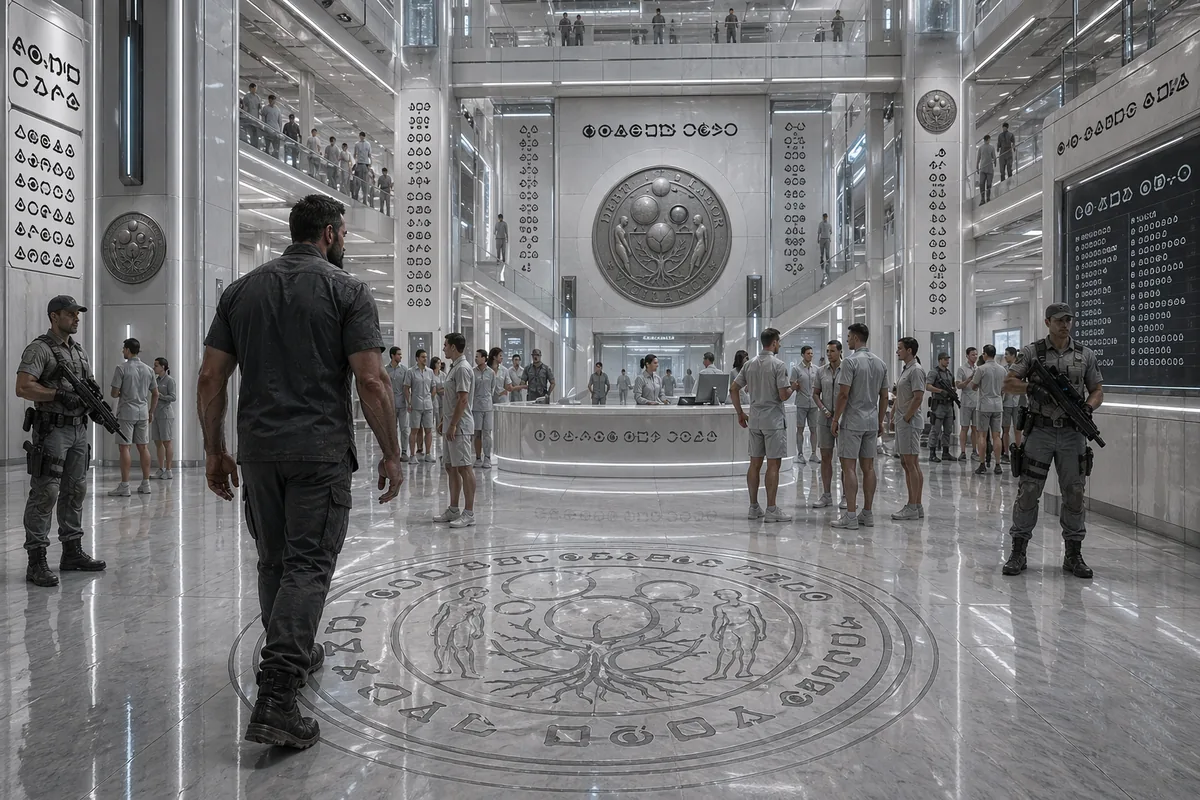
Security waved him through with practiced indifference. Two guards, both younger than his debt. The lobby smelled faintly of disinfectant and old circuitry, layered beneath it the dry, dusty note of a building sealed too long against air it did not trust.
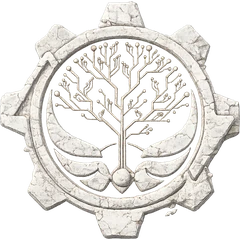
In the floor, the Crest of the Faith was inlaid in stone, worn smooth by ten thousand shoes. DEBT still readable. LABOR half-gone. VIGILANCE entirely erased. Nobody had repaired it. Nobody would.
The receptionist confirmed what he already knew, eyes flicking briefly to his name before returning to the screen.
"Sixtieth floor," she said. "Stair access only today. Elevators are offline for inspection."
The elevator was the only honest thing in the building. It admitted it did not work.
Harri nodded once.
The stairwell was narrow and gray, concrete walls scarred with old paint marks and numbers stenciled every ten floors. The air inside was stale and warm, trapped heat that smelled of old rubber and dust.
The first flight burned. His knees objected. His back filed a formal complaint. The implant ticked upward, a small adjustment, an interest-rate increase on a loan he had not taken out.
The second flight made his vision swim. He gripped the rail and waited for the walls to stop trading places. His shoulder ground against something and he did not care what.
Not as punishment. As correction.
The words arrived uninvited. The Red Priest's voice, or the shape of it, pressed into the bone behind his ear where the device sat. Harri did not argue with it. He could not afford to. Arguing cost breath and breath was capital and he was climbing sixty floors on a deficit.
By the fifth flight, sweat soaked through his shirt. Each step was a line item. Each landing a subtotal. He counted floors by the stenciled numbers because counting was cheaper than thinking.
By the seventh, the stenciled number on the wall said 7 and Harri thought: fifty-three to go. Then he stopped thinking about numbers because the mathematics of the thing was worse than the climbing.
By the eighth, his cut arm began to throb in time with his pulse. He switched hands on the railing. The other hand was worse. He switched back.
By the tenth, the implant flared, hot and spreading, and his grip on the railing went white. The pain filled his skull and then spilled downward through his chest and into his legs, which kept moving because stopping was a decision and decisions cost more than steps.
The debt of breath.
He stood on the landing until his lungs stopped charging him double. Then he climbed again. One flight. Another. The numbers on the walls ticked upward in intervals of ten and the intervals between them stretched longer each time.
By the fifteenth, the rhythm had settled. Not comfort. Rhythm. The body finding a rate it could manage, the way a debtor finds a payment schedule that does not quite kill him.
The pain had found a rate he could service. Interest, not principal.
By the twentieth, his breath came in harsh, measured pulls. His shirt was dark with sweat. His cut arm throbbed with each heartbeat, vision blurring at the edges on every other step. His knees had stopped complaining and started simply refusing, each bend a negotiation, each straightening a concession.
Your labour is your offering.
He did not stop. He had never been good at stopping. That was not a virtue. It was a deficiency in the mechanism that tells a man when he is finished.
Somewhere past the thirtieth floor he lost count. The stenciled numbers blurred. The landings repeated themselves, each one identical, each one a receipt for a flight he had already paid for. The implant pulsed in steady waves now, almost predictable, almost tolerable, the way a man can learn to sleep next to a noise if the noise is consistent enough.
Each step echoed in the stairwell, slow and deliberate, carrying him closer to the only thing left that still had a name.
Thelian.
And the ninety-eighth floor.