Blood Isuule
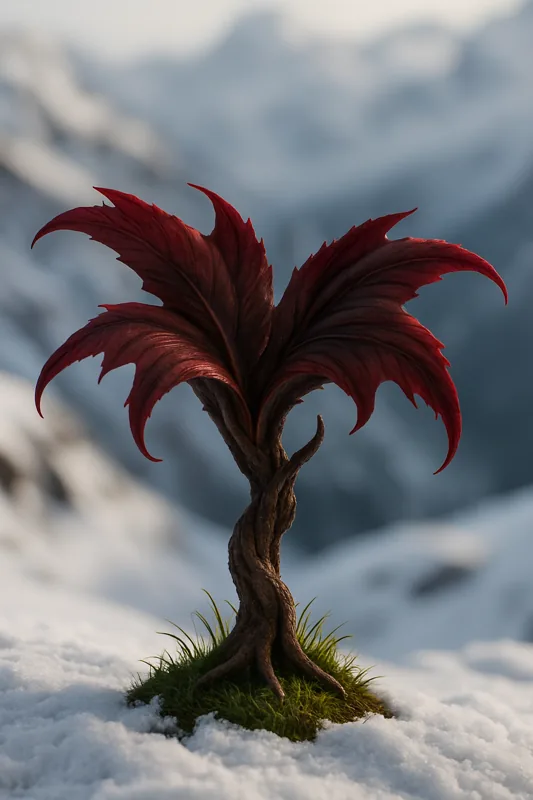
The Blood Isuule rises from broken soil like a wound refusing to close, its twisted fibrous stems coiling upward into wide, blood-coloured serrated leaves that dry and claw inward at the outer edges as the plant matures, sometimes piercing its own heart Place The Heart A ring of sacred islets in the western ocean off Iruel, the Iru homeland whose faith is the Ooliran Sovereign Breath. and casting the broken shell to the wind as a new dispersal vessel. It thrives in disturbed, blood-soaked, or ruinous ground across Northland Place Northland The northern continent of Elshore, called Northland in common speech, on which every chapter of the story so far unfolds., carpeting old battlegrounds, grave-fields, and the sites of forgotten betrayals. Every part of the plant is toxic, and its carnivorous lure at the base draws both insects and, by scent, larger and far more dangerous creatures from the surrounding wilds.
Key traits
- As leaves dry and claw inward, old plants collapse and their central spore-nodes break open, scattering dust-like spores across the dead ground and wind.
- A soft, nectar-seeping seat at the base of each plant lures insects and small scavengers; paralytic compounds bind prey until it dies, and decomposition feeds the plant through deep taproots.
- Where large animals or the dead are left to rot, Blood Isuule clusters bloom thick and fast, covering bodies in tangled bushes of red-veined claw-leaves within weeks.
- The sap is toxic, the roots tainted, and the sweet scent near-lethal to small creatures over long exposure; burning dried fibres releases choking fumes that cloud the mind and burn the lungs.
- The plant's scent carries an ecological link to apex predators of the northern wilds, making harvesting it without knowledge of local fauna a perilous undertaking.